


Five months into the global pandemic and with just over 100 days before the general election, we check in with the latest polling on how voters are feeling about health care in the U.S.
Click here for more of our coronavirus coverage.
How the Public Feels About Health Care Right Now in 5 Charts
We last talked to Kaiser Family Foundation pollster Ashley Kirzinger in early February about the role health care was likely to play in the 2020 election. Then the pandemic hit.
Ashley and her colleagues have completed seven polls since late February measuring people’s thoughts on health care and the pandemic, with the latest coming out on July 23. Below are five charts that capture how the public is feeling about health care in this moment.
1. Little Change on Major Health Policy Divisions
“If there was anything that was going to shift public opinion towards expanding coverage and moving us away from an employer sponsored system, this would be it,” Ashley said of the pandemic.
But their polls over the course of the last several months show little change in people’s attitudes toward Medicare for All, a public option and the Affordable Care Act, with partisan divides remaining strong.

2. There Might Be Some Movement on Medicaid
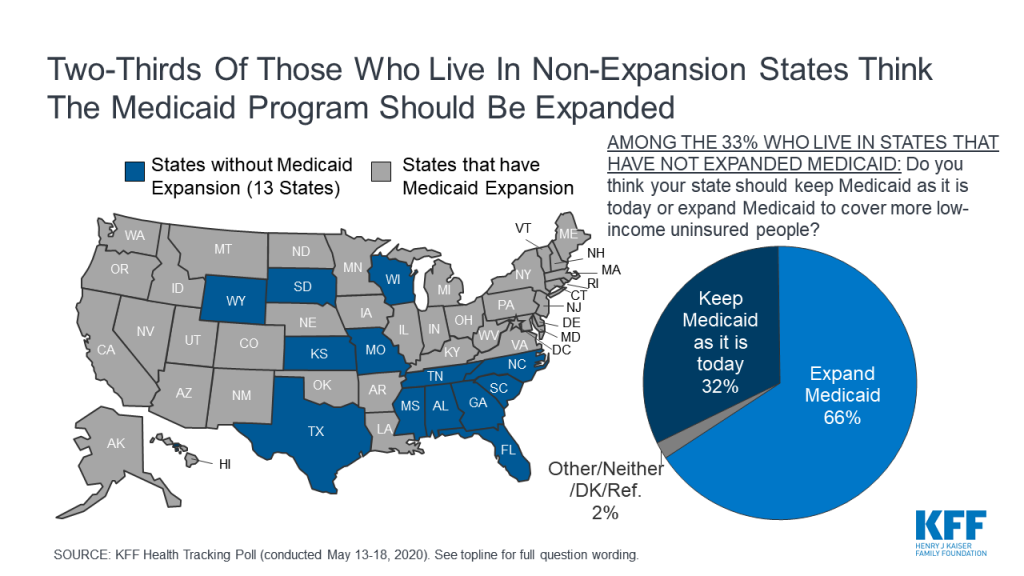
The one place where KFF’s polling has detected some changing views is around Medicaid. One-third of people say that they or someone they live with will likely need Medicaid in the next year, and two-thirds of people living in states that have not expanded Medicaid say they support expansion, up from 61% in February 2020 and just 51% in July 2018.
“It’s hard to determine causality,” Ashley said of the change in support, “but it makes sense that as more people have to rely on Medicaid for health coverage that we would see more people having favorable views of the program.”

3. Concern Over School Reopening
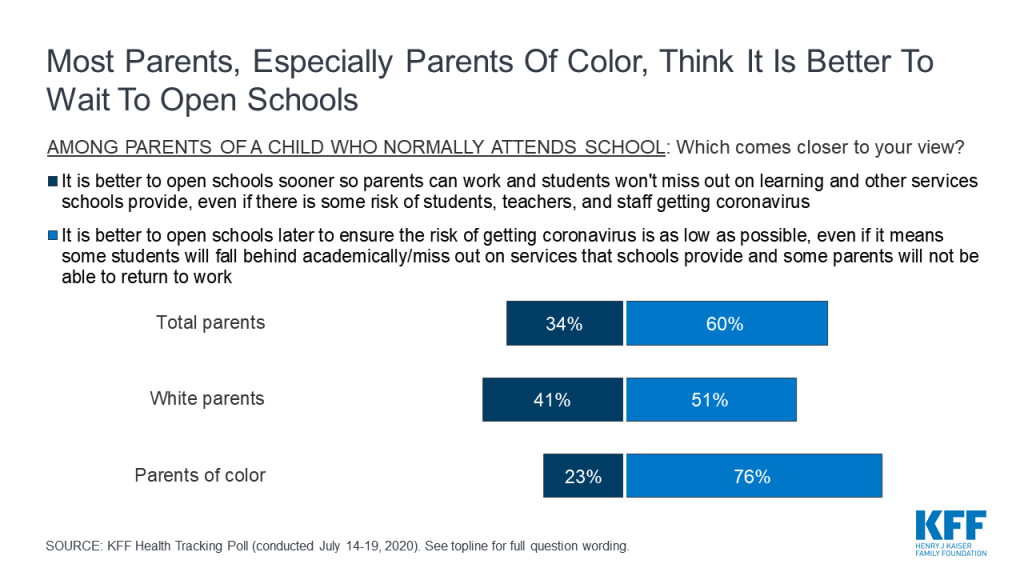
Sixty percent of parents with kids in school would prefer to wait until the risk of coronavirus transmission is much lower before restarting in-person instruction, including 76% of parents of color.
More than two-thirds of parents and the public at-large say that schools in their area need more resources to safely reopen, and 55% believe additional funding to support schools should be a top priority for Congress.

4. People Want Congress To Do More
Almost half of the public rated the federal government’s response to the pandemic so far as “poor.”
Seventy-two percent of the public say increasing federal funding for testing, contact tracing and personal protective equipment should be a top priority for Congress, with less and more politically divided support for other measures.
“Very few when we ask about this list of priorities, say that this shouldn’t be done at all,” Ashley said. “So they’re just looking for action from Congress and their federal government.”

5. Pessimism and Mental Health Toll is Getting Worse
“What is becoming increasingly clear is the surge in cases, the pushes to reopen both businesses and schools, is having a direct negative impact on the public’s mental health,” Ashley said.
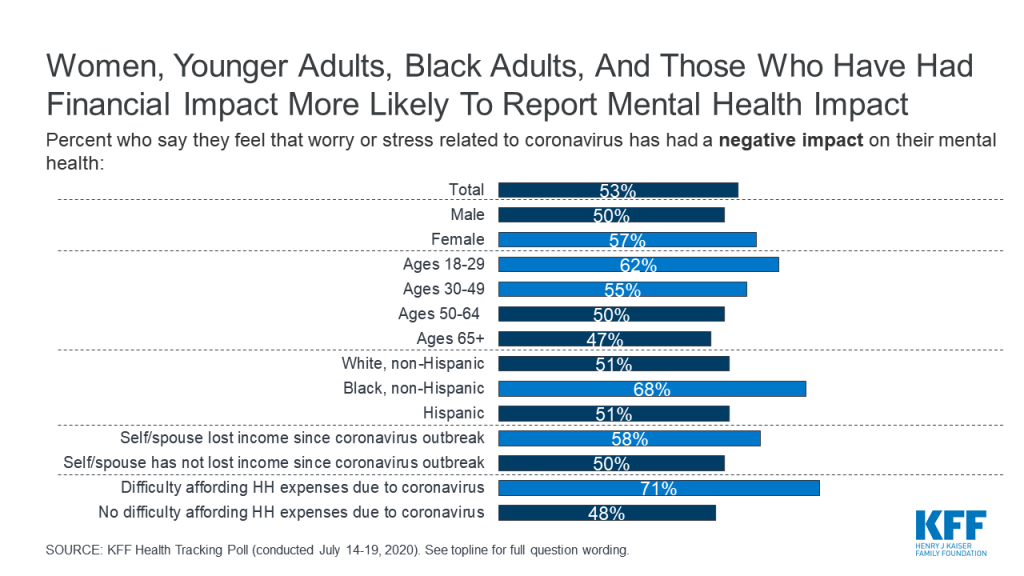
After months of plateauing rates of optimism around the pandemic, 60% now say the worst is yet to come, up 10 percentage points from May. Fifty-three percent say they’ve experienced negative mental health impacts from the pandemic, up 14 percentage points from May.



Episode Transcript and Resources
Episode Transcript
Note: This transcript has been created with a combination of machine ears and human eyes. There may be small differences between this document and the audio version, which is one of many reasons we encourage you to listen to the episode!
Dan Gorenstein: When 2020 began, a lot of people were talking about health care.
Vice President Biden: I’ve added to Obamacare plan, the Biden initiative, which is a public option…
Sen. Bernie Sanders: What Medicare for All would do is save the average American substantial sums of money.
President Donald Trump: I’m calling for bipartisan legislation that achieves the goal of dramatically lowering prescription drug prices.
DG: Then came COVID, and a lot of people are still talking about health care. But the conversation sounds really different.
Biden: I’m releasing a plan to combat and overcome the coronavirus.
Sanders: Our country is facing a medical and economic crisis.
Trump: We are using the full power of the Federal Government to defeat the coronavirus.
Some five months into the global pandemic, and with just about 100 days before the general election, we check in with the latest polling on how voters are feeling about health care in the U.S.
From the Annenberg Studio at the University of Pennsylvania, I’m Dan Gorenstein, and this is Tradeoffs
DG: Ashley Kirzinger, Kaiser Family Foundation pollster extraordinaire, welcome back to Tradeoffs.
Ashley Kirzinger: Yeah. Thanks for having me. Sad to not be in the studio together.
DG: We first talked with Ashley at the beginning of February on the heels of the Iowa caucus.
CBS: On the second day after the Iowa caucus the latest results show Pete Buttigieg and Bernie Sanders in a tight race.
DG: The world has obviously changed a lot since then, and Ashley and her colleagues at KFF have been following the public’s response to the pandemic in monthly tracking polls.
The most recent came out today, Thursday, July 23.
But before we asked Ashley about her latest findings, I wanted to know what overarching questions have been driving her polling since the pandemic began.
AK: So we wanted to know if people were worried about losing their coverage; we wanted to know if people thought that the system that we have in place was well suited to deal with this type of pandemic and public health crisis; and we wanted to know if it had shifted their opinions about health care policy writ large.
DG: And on that last point, why would you want to know if the pandemic would change people’s attitudes about major health policies?
AK: We had found that every time we had asked these questions, people had fallen back to partisan answers, with Democrats supporting Medicare for All but larger shares supporting a public option and then still supporting the Affordable Care Act, and Republicans disapproving of really all three of these proposals. As a pollster that has been looking at all of these health policy proposals for many years, if there was anything that was going to shift kind of public opinion towards expanding coverage and moving us away from an employer sponsored system, this would be it. This is the type of crisis that could result in monumental shifts.
DG: One of the questions that I get asked is how will this pandemic change the U.S. health care system? Is it going to really move the needle on any of the big policy disagreements that we’ve had, just what you’re talking about — the ACA, Medicaid, universal health care coverage. So being out in the field over the last five months or so, has the pandemic changed the way we think about these really divisive issues?
AK: So it really hasn’t changed the way we view the Affordable Care Act. It’s really partisan. We find very similar things with Medicare for All and the public option. What we may be seeing is change in views of Medicaid. We’re actually finding that about one-third of households now say that it is likely that either they or someone in their household will have to rely on Medicaid in the coming year. We know that those living in states that haven’t expanded their Medicaid programs, we are seeing some shift in support. The last time we polled on it was in February 2020, so right before the pandemic, and it was 61% to where we are now which is closer to 67%. So if we’re seeing any shift at all, Medicaid seems to be the only program in which there is some shift in support.
DG: And you attribute some of that growth at least to the pandemic, to COVID?
AK: It’s hard to determine causality, but it makes sense that as more people have to rely on Medicaid for health coverage, that then we would see more people having favorable views of the program.
DG: It seems like each week, the new big thing people are worried about and focused on…
NBC: Across the country, we’re seeing an alarming rise of coronavirus cases at nursing homes.
DG: Sort of lurches from one issue to the next…
ABC: Coronavirus cases surging in Texas. Hospitalizations there breaking records two weeks in a row.
DG: And for the last several weeks, Ashley at’s been schools.
CBS: Many teachers across the country are pushing back on plans to bring students back to the classroom.
DG: What did you guys find about people’s thoughts and attitudes on what to do about reopening the schools?
AK: So largely, people don’t think schools should open until the risk of getting coronavirus is as low as possible. Even if that means that students will maybe miss out on certain services or fall back academically. This is largely supported by Democrats, independents, less so for Republicans and largely supported by parents, especially people of color who are parents. So three-fourths of them think that schools shouldn’t open until the risk of contracting coronavirus is very, very low.
DG: Did you ask folks about economic support for schools and for schools reopening?
AK: What we found is that 55% of the public say that increased federal funding to state and local governments to help schools safely reopen is a top priority. When we ask parents about their child’s individual school, two-thirds say that their school needs more resources before it can safely reopen.
DG: With lawmakers getting ready to hammer out another coronavirus relief package that may top out somewhere around $1 trillion, Ashley and her team asked Americans what they want to see in that deal.
AK: The public is prioritizing right now increased federal funding for testing, contact tracing, personal protective equipment for health care workers, as well as, as I mentioned earlier, increased federal funding for state and local governments to help schools safely reopen. But I think it’s important to note that the public is largely looking for Congress to do something. Right now, less than half of the public rate any level of government’s response to the corona virus as either excellent or good. And the federal government does much worse with 48% rating the federal government’s response to coronavirus as poor. So they’re just looking for action among Congress and their federal government.
DG: What do you feel like you know after this poll that you did not know before you got back into the field in the middle of July?
AK: What is becoming increasingly clear is the surge in cases and the pushes to reopen both businesses and schools is having a direct negative impact on the public’s mental health. So if we think back to at the beginning of the pandemic, about one-third found that the coronavirus was having a negative impact on their mental health. Now we’re seeing more than half of Americans saying that worry and stress related to the coronavirus has had a negative impact on their mental health. And now we’re finding that people are once again thinking that the worst is yet to come. We had seen that dip over the course of the summer, but now it is up to 60% of the public. I think that things opening and then closing and the uncertainty of what school situations are going to look like in the fall have really, you know, people are taking this very seriously and are very worried about what the fall is going to look like in the U.S.
DG: Any silver linings, Ashley Kirzinger, before we let you go?
AK: I really want there to be one. That there’s support for, some congressional action, that the public is wanting someone to be the leader in this. And so if someone can step up, they’re willing to support them.
DG: Ashley Kirzinger, thank you very much for taking the time to talk to us on Tradeoffs.
AK: My pleasure.
DG: In addition to talking with Ashley, we’ve been checking in with individual voters across the country this week, asking them how they’re feeling about health care policy and the coronavirus in this moment.
Voter 1: I think they should’ve been taking better care of our elderly.
Voter 2: The government should help support people somewhat, but I don’t think it should go on forever.
DG: We’ll have more from those interviews in our weekly newsletter, which hits inboxes every Friday morning. If you’re not already signed up, you can subscribe by clicking the big orange link at the top of our website, tradeoffs.org.
I’m Dan Gorenstein. This is Tradeoffs.
Episode Resources
Relevant Kaiser Family Foundation Polling:
- July 2020 Tracking Poll
- Health Tracking Poll Archive
- Interactives: Tracking Public Opinion on a National Health Plan and the Affordable Care Act
- Other Select Research and Reporting:
- Older Children Spread the Coronavirus Just as Much as Adults, Large Study Finds (Apoorva Mandavilli, New York Times, 7/18/2020)
- Lawmakers Are Far Apart On A New Coronavirus Relief Bill. Here Are 5 Sticking Points (Deirdre Walsh and Domenico Montinaro, NPR, 7/21/2020)
- How States Are Facilitating Medicaid Enrollment During COVID-19—And How They Can Do Even More (Rebecca Landucci, Jennifer E. Moore, Clare C. Brown, Caroline E. Adams, Nicole Truhe and Mark Larson; Health Affairs; 6/17/2020)
Episode Credits
Guest:
- Ashley Kirzinger, Associate Director of Public Opinion and Survey Research, Kaiser Family Foundation
Music composed by Ty Citerman, with additional music from Blue Dot Sessions
This episode was produced and mixed by Ryan Levi.
Additional thanks to:
Nancy Clark, Clayton McCook, William Shelley, Pamela Blair, Tamika Wright, Alicia La Freniere, John Niepoetter, Larry Gilman, Jessie Cromah, Renoalda Scott, Tramel Wilson, Caleb Smith, Geraldine Stockwell, Stirling Sahs, Keshia Burney, Lamar Davis, the Tradeoffs Advisory Board…
…and our stellar staff!