


From restricting abortion to legalizing marijuana, voters are weighing in on a variety of significant state health policy questions this election.
Click here for more of our coverage of health care and the 2020 election.
NOTE: An earlier version of this episode said Washington D.C. was considering “decriminalizing” psychoactive plants like mushrooms. They were in fact only considering effectively decriminalizing them — by directing police to make enforcing laws related to this issue a low priority.
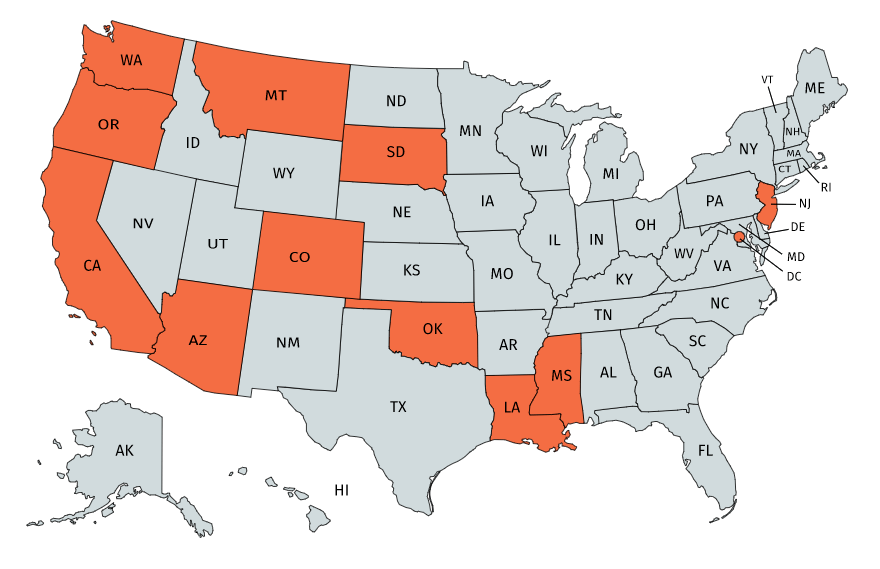
States with Health-Related Ballot Measures
The 2020 election has massive stakes, including for national health policies like the ACA and our response to COVID-19. Some states will also be voting directly on some interesting (and often contentious) health policy issues through ballot initiatives.
With help from Ballotpedia and the National Conference of State Legislatures (NCSL), we count 11 states, plus Washington, DC (in orange on the map), with health-related measures on their ballots. NCSL reports that, in general, the total number of ballot measures (124) this year is lower than usual, likely due to COVID-19 impeding the signature gathering process required for citizens to get initiatives on the ballot.
What’s on the Ballot?
Among these 17 health-related measures, the most common topic by far is the taxation and legalization of substances, including tobacco, marijuana and mushrooms. For more on the details and tradeoffs of those drug-related proposals, listen to our full episode featuring University of Maryland law professor Kathi Hoke.
Abortion Access
✓ Colorado: Proposition 115 bans abortion after 22 weeks unless required to save the mother’s life.
✓ Louisiana: Amendment 1 adds language to the state’s constitution declaring that “nothing in this constitution shall be construed to secure or protect a right to abortion or require the funding of abortion.”
Cigarettes and Vapes
✓ Colorado: Proposition EE increases cigarette taxes, imposes a new tax on e-cigarettes (also known as vapes) and allocates the revenues for health and education programs.
✓ Oklahoma: State Question 814 shifts how the state’s tobacco settlement money is spent, in part, to help fund Medicaid.
✓ Oregon: Measure 108 increases cigarette taxes, imposes a new tax on e-cigarettes (also known as vapes) and allocates the revenues for health programs.
Dialysis Clinic Regulations
✓ California: Proposition 23 requires dialysis clinics to have at least one licensed physician on site while patients are being treated and imposes new reporting requirements.
Long-Term Care
✓ Washington: Engrossed Senate Joint Resolution No. 8212 amends the constitution to allow the state to invest long-term care trust fund money in the stock market.
Marijuana Legalization
✓ Arizona: Prop 207 legalizes and taxes recreational marijuana use for adults 21 years and older. It also allows people to petition for the removal of marijuana-related crime convictions from their records.
✓ Mississippi: Ballot Measure 1 proposes two alternate approaches to legalizing marijuana for medical use.
✓ Montana: Initiative 190 and Constitutional Initiative 118 combine to legalize and tax recreational marijuana use for adults 21 years and older. Initiative 190 also allows people convicted of marijuana-related crimes to petition for re-sentencing or removal of the conviction from their records.
✓ New Jersey: Public Question 1 legalizes and taxes recreational marijuana use for adults 21 years and older.
✓ South Dakota: Constitutional Amendment A and Measure 26 combine to legalize marijuana for recreational use for adults 21 years and older and for medical uses.
Paid Medical Leave
✓ Colorado: Proposition 118 establishes a state program providing at least 12 weeks of paid family and medical leave funded by a payroll tax.
Psilocybin/Mushrooms
✓ Washington D.C: Initiative 81 directs police to de-prioritize the enforcement of laws related to psychoactive plants such as mushrooms.
✓ Oregon: Measure 109 directs the Oregon Health Authority to develop a program for legally administering psilocybin-producing products such as mushrooms.
Sex Education
✓ Washington: Referendum 90 implements Senate Bill 5395 requiring students in grades 6-12 receive comprehensive sex education.
Stem Cell Research
✓ California: Proposition 14 issues $5.5 billion in bonds to fund stem cell research projects and governance changes at the California Institute for Regenerative Medicine.
Episode Transcript and Resources
Episode Transcript
Note: This transcript has been created with a combination of machine ears and human eyes. There may be small differences between this document and the audio version, which is one of many reasons we encourage you to listen to the full episode below!
Dan Gorenstein: It’s Election Day.
News clip: US goes to the polls throughout the country…
DG: Most eyes – of course – are trained on the top of the ballot…,
Biden clip: We have to earn our democracy. We have to get out and vote.
DG: For one of the most anticipated presidential races in decades…
Trump clip: You have to get out and vote. We have to finish the job.
DG: But policy wonks and government geeks are also jazzed by what’s on the bottoms and backs of those ballots.
They go by many names…measures, amendments, propositions, referendums…and to some, they’re our country’s purest expression of democracy.
News clip: I’m not going to miss this vote. This is important to my kids’ future.
DG: Today we round up the health policy questions that states are putting straight to the people…from the Annenberg Studio at the University of Pennsylvania, I’m Dan Gorenstein, and this is a special Election Day edition of Tradeoffs.
By our count, 11 states plus Washington DC have at least one health-related measure on their ballots this year.
Voters in Louisiana and Colorado will weigh in on abortion access. In Califonia, it’s stem cell research and dialysis regulations. And in Washington, it’s sex education.
But by far the most popular topic is: drugs — tobacco, marijuana, even magic mushrooms.
We’ve invited University of Maryland law professor Kathi Hoke to dive a little deeper here, starting with the five states considering measures on marijuana.
DG: So before we get into the ballot measures themselves, can you help us understand, Kathi, when something like marijuana legalization ends up going directly to the voters, why is that usually the case?
Kathi Hoke: I think the reason they go to the ballot is the reason, frankly, almost anything somewhat controversial goes to the ballot, such as gay marriage. It’s because legislators have a fear of casting that vote. You may be able to tell them that 75 percent of Americans support at least medical marijuana, if not recreational use marijuana, and yet they are afraid to cast that vote.
DG: Let’s set the stage. What is the state of the state laws on marijuana heading into this election and — no pun here — at a high level, where are things as of today?
KH: So as of today, 33 states have medical marijuana access and 11 states have recreational access. And within those medical marijuana states, there is a great deal of variation between who can participate on the business end, who can have access, where can these products be made available, and then kind of the how. And so while there are 33 states, there are probably 33 different laws and 33 different programs on medical access. You see slightly more uniformity in the 11 recreational use states.
DG: Obviously, marijuana is still illegal at the federal level. But what’s the general attitude or approach to state action on marijuana?
KH: Under the Obama administration, the Department of Justice had issued essentially letters of assurance to those participating in state-regulated medical cannabis programs that there would not be federal action if there was compliance with the state regulation. The Trump administration pulled those letters of assurance, if you will, and didn’t replace them with anything. So if you’re waiting around for the feds to do something about marijuana, I say, don’t hold your breath. Exhale.
DG: You know, that was bad, right?
KH: Yeah, pun intended [laughs]
DG: And Kathi, what’s really the main policy motivation for these states moving to legalize marijuana?
KH: I do think that by and large, states that have adopted, particularly the recreational use or the adult use, have done so in the hopes of bringing in a significant amount of revenue from regular sales tax, from an excise tax and from the licensing scheme, because in most states, the licenses cost pretty penny. For the medical marijuana, it’s more about providing access to care for people who need it. Even in the recreational use states, there is another significant motivation, and that is principally the decriminalization of marijuana as a way to at least prevent additional harm to the communities that have been most impacted by the drug wars.
DG: So five states have some sort of initiative on the ballot this year relating to legalizing marijuana either for recreational or medical use. If these five states end up passing these measures, do you think we could be near some sort of tipping point in the country?
KH: I don’t know if that means we’re more likely to see federal action but what I do think is, you know, some of these states are what I’d call tipping states. If New Jersey passes this recreational use, the close neighbors of Pennsylvania, Maryland and New York, I think, are very vulnerable to passing it themselves, both from a competition perspective — not wanting to lose the revenue — and from the social acceptability perspective. And then we look at the three other states, Arizona, Montana and South Dakota, and you’re looking at conservative states — red states — that will have adopted this provision. That may signal to other conservative states that are going to be in significant fiscal crisis as a result of the pandemic that this may be a way to bring in money and that it is palatable from a political perspective, even in conservative states.
DG: Kathi says one interesting note about the measures in Arizona and Montana, both would make it easier to remove past marijuana-related convictions from a person’s criminal record — a provision not seen in earlier laws.
When legalizing marijuana first became a policy debate a decade ago, there’s a lot of talk about, sorry for this, tradeoffs. Yeah, sure, states could make big tax dollars, but at the same time, we might see more accidents caused by driving or being under the influence in some way or more young people getting hooked to these drugs. When you look at the data out of these early adopter states — Colorado, Washington — what’s the story there? What has actually happened on these important public health questions?
KH: So far, the data tells us that we are in a good place from a public health perspective in permitting recreational use of marijuana, as long as we keep our focus on preventing marketing to and access to people under 21. Concerns about massive increases in intoxicated driving, concerns about overuse or, concerns about people maybe being not safe in their place of employment…we’re not seeing it. I think the subtext there is people have been using marijuana in this country for decades. And so to the extent that recreational use becomes lawful, there’s not a massive increase in the number of people who use it. It just changes who makes the money, how safe it is for people, and obviously does away with the inequitable treatment from a criminal perspective.
DG: It sounds like what you’re saying to us, Kathi, is that when you review the literature, there’s no real downside that is coming as a result of these laws. Is that right? There’s no downside?
KH: No is such a big word with its two little letters [laughs]. So I’m a smart enough lawyer to not say no downside. But the measures that we were looking for and concerned about that I mentioned, we’re not seeing. As we’re progressing through additional states, adding programs there may be concerns that get, you know, that come to light. But right now there aren’t significant negative public health outcomes here that people feared.
DG: There’s another kind of smoking on the ballot in a couple of states, both Colorado and Oregon, are proposing to increase cigarette taxes, but also to begin taxing e-cigarettes or vapes. What are the key policy considerations for this issue?
KH: So this is, I think, purely driven by a desire to increase revenue. And the legislature has punted this or, you know, put it before the voters again so that they don’t look like they’re imposing a tax on people.
DG: And what about public health considerations? Are these taxes intended at all to curb smoking?
KH: Yes, there is some data that tell us, particularly for very young people — we’re talking our 14s to 16s — a decreased likelihood of using these products, tobacco products of any sort, if they’re priced out. They’re very price sensitive. And we do know if we can keep kids away from smoking before they’re 21, the likelihood of them becoming daily smokers is almost nil. But beyond that, we don’t see a lot of shifting, even with increased taxes among adult users because it is an addictive substance. So once you are addicted, you’re going to sacrifice perhaps the Starbucks coffee. Well, I guess that’s addictive, too. [laughs] So, I mean, think of a different example. You’re going to give up perhaps your Netflix subscription so that you can continue to purchase your cigarettes because you’re addicted.
DG: There’s also a couple of measures about…mushrooms.
Oregon’s got one that would legalize mushrooms and other psychedelic plants for medical use.
And Washington D.C. is also considering a plan to effectively decriminalize these plants.
It’s called — and I love this — the Entheogenic Plant and Fungus Policy Act of 2020.
Kathi, are these kind of progressive outliers or do they signal something bigger about where other states may be headed?
KH: I like your term progressive outliers, and I think they are such outliers that they’re lying outside of the science. I think we don’t know yet enough about the use of these products. So we would want to see far more to demonstrate the safety and efficacy of their use for medical purposes. And then we’d want to know far more about the impact on people for, you know, extensive or extended use over time. We simply don’t have that data.
DG: One other measure in Oregon: decriminalizing small amounts of hard drugs like heroin and cocaine. Kathi says the state could decide on their own to deemphasize arrests and prosecutions for those drugs but that it’s politically safer to let the people decide.
KH: They don’t need a ballot measure for doing that. That seems like a discretionary approach by the police and by prosecutors. But they want to put it to the people before they decide.
DG: Kathi, thanks very much for taking the time to talk to us on Rradeoffs.
KH: Absolutely. My pleasure. Thanks for having me.
DG: Given the issues likely to come before the new more conservative Supreme Court — abortion, same sex marriage — Kathi expects state ballot measures to play an even more prominent role in elections to come.
I’m Dan Gorenstein and this is Tradeoffs.
Episode Resources
Select Reporting on 2020 State Ballot Measures:
- Ballot Measures: A National Rundown for 2020 (Louis Jacobson, University of Virginia Center for Politics, 10/27/2020)
- In the Pandemic, a Shifting Ballot Debate on Legalizing Drugs (Kirk Johnson, New York Times, 10/26/2020)
- 2020’s marijuana legalization ballot measures, explained (German Lopez, Vox, 10/16/2020)
- Women’s Health on the Ballot (Michelle Long, KFF, 10/15/2020)
- State Elections 2020: Health Ballot Measures (Kate Bradford, NCSL, 10/12/2020)
Episode Credits
Guest:
- Kathleen Hoke, JD, Professor, University of Maryland Carey School of Law; Director, Network for Public Health Law Eastern Region
The Tradeoffs theme song was composed by Ty Citerman, with additional music this episode from Blue Dot Sessions.
This episode was reported and produced by Leslie Walker. It was mixed by Andrew Parrella.
Additional thanks to:
Trish Riley, the Tradeoffs Advisory Board and our stellar staff!