


Debates in state capitols over how to fill gaps in the country’s COVID-weary health workforce are reigniting long-standing turf wars among professions.
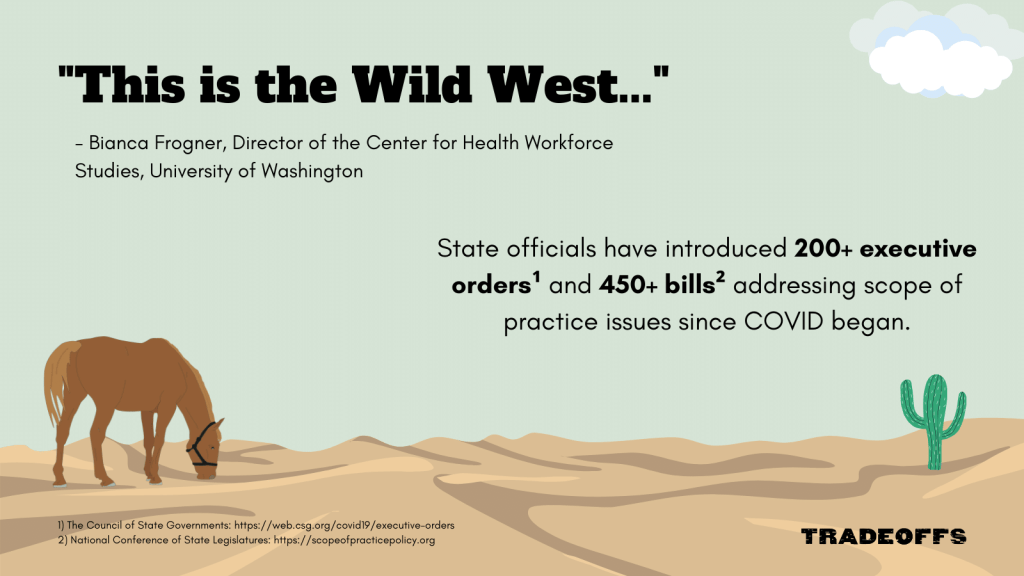
Who is allowed to care for patients? And when, where and how can they do it? Those questions have been the focus of more than 450 bills and 200 executive orders introduced in state capitols since COVID-19 hit. “This is the Wild West,” said Bianca Frogner, director of the University of Washington Center for Health Workforce Studies.
“Every state was scrambling to get the people that [they needed],” Frogner said, describing the early days of the pandemic when lawmakers took bold measures, from calling nurses out of retirement to graduating medical students early.
“And they realized one way to solve this problem [was] to revisit some of these regulations,” she said. Those regulations, commonly known as scope of practice rules, define the limits for each health profession — the services they can provide, the licensing and oversight they require. Relaxing those rules offered lawmakers a fast lane to increasing workforce capacity.
But many of the emergency measures states enacted are now expiring. Legislators are debating which to make permanent and how else to bolster a COVID-weary workforce. Health professionals from pharmacists to physician assistants are jockeying to shape this next wave of workforce reforms.

“It just makes me feel helpless”
A recent legislative dust-up in Denver, Colorado offers a lens into the drama playing out in state capitols across the country. Earlier this year, the Colorado House of Representatives considered HB1095, which would have enabled physician assistants, also known as physician associates or PAs, to practice more independently.
Like in many states, Colorado PAs currently have the power to diagnose, treat and prescribe — but only with oversight from a doctor. Advocates for more authority for PAs argued reducing those oversight requirements made sense in a state where 75% of counties are rural.
“On average, it can take anywhere from one to three years to recruit a physician to rural Colorado,” Kelly Erb of the Colorado Rural Health Center told lawmakers.
PAs like Susanna Storeng, who practices in a rural area, argued that current law overly restricts the scope of services physician assistants can provide. “It’s crushing not to be able to do something you know you’re able to perform,” Storeng said in an interview.
Although Storeng is trained to place long-acting contraception like IUDs in patients, state law prohibits her from doing it. That’s because the physician who currently supervises her does not offer that service. Storeng estimated she refers roughly seven patients each month to other providers for contraceptive services.
Storeng worries often about one patient in particular — a young woman struggling with a methamphetamine addiction, desperate to avoid becoming pregnant. Storeng could have placed the contraceptive implant the patient wanted in under 20 minutes — as she had done at least 100 times for others under prior supervising physicians.
Instead, she had to schedule the patient an appointment with another provider. The patient never showed up. “It just makes me feel helpless,” Storeng said.
Scope expansion efforts meet stiff resistance
Before a final House vote on HB1095, which would have allowed Storeng to provide the full scope of services she’s trained in, Colorado lawmakers engaged in nearly an hour of testy debate.
“To diminish what a PA does…is so unfair and it’s really disrespectful,” said Rep. Brianna Titone, chastising doctors who raised questions about the safety and quality of care that PAs might provide without supervision.
“There’s a reason that doctors have to undergo almost 10 times as much clinical hours as a PA does,” argued Rep. Colin Larson.
That was a message echoed loudly — and with significant financial backing — by physician trade groups like the Colorado Medical Society. Researcher Bianca Frogner said the data do not support the safety concerns raised by some doctors, but they seemed to resonate nonetheless. Ultimately, HB1095 failed by seven votes.
Long-standing turf wars resurface
Nationwide, PA groups recently helped pass bills allowing their members to practice more independently in Wyoming and Utah, but they ran into resistance elsewhere — as have other professional groups. Only about one-third of the scope of practice bills introduced in the last two years have been enacted, according to a National Conference of State Legislatures database. The American Medical Association takes credit for working in 25 states this year to stop nurses, PAs and other providers from gaining more authority.
These types of turf wars among health professions have raged for decades — often between occupations with less training and lower pay and their more powerful counterparts. The controversies are resurfacing as lawmakers look for solutions to the workforce woes that COVID highlighted and, in many cases, worsened. Professional groups are essentially competing for that business, arguing their members can meet states’ needs better, faster and in some cases, more cheaply.
Even if more laws like HB1095 succeed, data suggest they may have limited impact. One study of a Massachusetts emergency order waiving supervision requirements for some nurses found that 75% of nurses surveyed felt the measure had not improved their work environment. Experts point to employer policies and health insurer reimbursement rules as other important levers.
A problem of national concern
Most alarming to Bianca Frogner, though, is the dizzying number of different ways states are approaching these scope of practice issues. It’s a sign, she said, of a fundamental flaw in how the U.S. regulates its health workforce. “What health care workers can do is really decided at a state level.”
The lack of overarching federal regulations and coordination, said Frogner, makes it hard to get workers where they are needed most, especially during a crisis like COVID. Inconsistent state laws, she said, also contribute to wide geographic variations in the quality and cost of care that people receive. “We need more strategic planning happening at a national level.”
She said COVID could still force lawmakers to take more national action sooner than later: “The pandemic is slowing down, but it’s not over.”
Tradeoffs’ coverage of the impact of COVID on the U.S. health care system is supported, in part, by the National Institute for Health Care Management Foundation
Episode Transcript and Resources
Episode Transcript
Note: This transcript has been created with a combination of machine ears and human eyes. There may be small differences between this document and the audio version, which is one of many reasons we encourage you to listen to the episode!
Dan Gorenstein: When COVID first hit, lawmakers worried America would run out of health care workers.
Gov. Pritzker: We’re in the middle of a battle, and we need reinforcements
DG: They pulled every lever they could find…
News: Doctors and nurses are being called out of retirement to help their weary colleagues.
DG: Unleashed a flood of waivers, declarations, emergency orders…
News: Nearly 2,000 med students graduated months early to join the fight against the coronavirus.
DG: A slew of changes to the status quo relaxing rules of who could care for patients, when, where and how.
News: Dozens of San Diego dentists have signed up to be a part of the solution.
DG: Now these temporary measures are expiring, and health professions from pharmacists to physician assistants are jockeying to shape the next wave of workforce reforms. Today, how COVID reignited turf wars between health workers and the lawmakers caught in the middle.
From the studio at the Leonard Davis Institute at the University of Pennsylvania, I’m Dan Gorenstein. This is Tradeoffs.
****
Colorado House Archive: Welcome everyone to the Health and Insurance Committee.
DG: On February 23, 2022, a small group of Colorado lawmakers wanted to take action.
Rep. Lontine: This bill will increase access to care. If I’ve heard anything this year it’s that we don’t have enough providers.
DG: This bill, HB1095, is one of more than 450 different bills that state lawmakers have introduced since COVID hit. They address who can practice what, where, when and how — issues often called ‘scope of practice.’
COVID had prompted Colorado — and virtually every other state in the nation — to take a harder look at ensuring the state had a healthy supply of workers. The goal of HB1095 was to help physician assistants, or PAs, do more for more people. And that small group of Colorado lawmakers liked it.
Colorado House Archive: Representative Baisley. Yes. Froelich. Yes. Luck. Yes. McCormick. Yes.
DG: The committee passed the bill with flying colors: 10 to 1.
PAs in Colorado are licensed to do the major medical stuff — diagnosing, prescribing, treating — but only with supervision from a doctor. This bill would nix many of those oversight requirements, freeing up people like Susanna Storeng, who told lawmakers she could provide more care to more patients.
Storeng House Testimony: The system is not working. Rural Colorado needs health care, and PAs are vital in providing this health care.
DG: Susanna’s a PA at High Plains Community Health Center in Prowers County, Colorado. Prowers and its 12,000 residents sit on the border of Colorado and Kansas…so far out there, says Susanna, they’re not considered rural…they’re remote.
Susanna Storeng Interview: The closest tertiary hospital — meaning if you had a heart attack, where would you go — it’s three hours away. You would go by an air ambulance.
DG: Susanna told lawmakers practicing medicine in rural America is all hands on deck all the time. And the way Susanna saw it, Colorado’s law had tied one of those hands behind her back. Three-quarters — 75 percent — of the state’s counties are designated rural or frontier and the House reps from those districts echoed Susanna’s argument.
Rep. Will: If I’m out in Eads, Colorado or Cheyene Wells and a horse steps in the badger hole and rolls over on me, when you’re in that situation, you don’t care if you’re seeing a PA or a physician. You just want some kind of medical health care. And, and that’s what we’re talking about in this bill.
DG: Two weeks after its first legislative win, the bill cleared its next hurdle 54 to 10. The full House scheduled one final vote for a few days later, but even with all this momentum, a showdown was looming.
A few physician groups had lined up against the move, claiming unsupervised PAs put patients’ health at risk. Of course, those same docs had the most to lose if PAs gained power.
Susanna Storeng and others argued patients’ health was at risk if lawmakers stuck with the status quo. Susanna saw this firsthand with a patient in her early 20s who struggled with meth addiction.
One day the patient’s mom called Susanna.
SS: And mom said she really wants to not get pregnant because she’s working diligently on quitting.
DG: Susanna had implanted a long-acting contraception in the patient’s arm after her pregnancy three years ago. Now she needed a new one. But under Colorado’s oversight law, PAs can only provide the services their supervising doctor provides — even if they’re treat other conditions. Susanna’s new supervising doctor didn’t offer this kind of contraception so Susanna was stuck.
SS: I said, “I can’t do it right now. I’m really sorry. We’ll get you an appointment to see the nurse practitioner.” So an appointment was made and she didn’t show up.
DG: A few weeks later, her mom called again. And again, Susanna had to pass her off.
SS: I know this patient. She knows she can come to me and seek guidance and seek my help for any of her health care needs, but not this.
DG: This…a procedure Susanna had done at least a hundred times. The patient missed her second appointment. The nurse, already stretched thin, refused to reschedule. Susanna worried this woman may get pregnant and put her and her baby in danger.
SS: I came into this profession to serve people, not to harm them. It’s crushing not to be able to do something that you know you’re able to perform.
DG: On the eve of the final House vote, the legislative landscape felt so promising.
The pandemic led 8 states to issue temporary waivers lifting this kind of physician supervision. In 2021, Wyoming and Utah passed laws permanently granting PAs more independence. Nationwide, the American Academy of PAs was so committed to reframing their role as collaborators not assistants they ditched the name “physician assistant” and now go by “physician associate.”
Colorado House Floor: [Gavel] With your unanimous consent the bills will be read by title.
DG: The final debate over HB1095 was fierce.
Rep. Larson: There’s a reason that doctors have to undergo almost 10 times as much clinical hours as a PA does.
Rep. Titone: That’s not fair at all to diminish what a PA does and the talents that a PA has…
Rep. Herod: Unfortunately, I don’t think that there are enough safeguards.
DG: The floor fight lasted almost an hour.
Colorado House Floor: All those in favor of House Bill 1095, please stand.
DG: 28 lawmakers voted yes.
Colorado House Floor: Thank you. You may be seated.
DG: 35 voted no.
Colorado House Floor: House Bill 1095 is lost [gavel]
DG: The bill was dead.
Advocates blame some of the bill’s defeat on heavy lobbying by physician trade groups. The Colorado Sun reported three of those groups combined to donate more than $100,000 to many of the members who helped sink the bill. Other states saw similar opposition. The American Medical Association takes credit for working in 25 states this year to stop PAs, nurses and other providers from gaining more authority.
These scope of practice ‘turf wars’ have raged for decades, but they’ve reached a fever pitch after the pandemic highlighted gaping holes in our health care workforce. As lawmakers look to fill those holes, professional groups are basically competing for that business, arguing they can do it better, faster and in some cases, cheaper.
Whatever reason Colorado’s bill failed, Susanna had to move on to her next big problem: Her supervising doctor is retiring in December. Without a replacement, there’s a chance she could lose her job, and so would 5 other PAs, leaving just 3 providers to care for her clinic’s 9,000 patients.
Colorado PA’s are gearing up for another legislative fight next year and Susanna hopes lawmakers see — unless they act — the situation will likely only get worse. After the break, putting Susanna’s saga in context, and the lessons a health workforce researcher has learned from the pandemic.
MIDROLL
DG: Welcome back. We just heard about the saga of one group of health workers duking it out with another — what’s known in health policy circles as a ‘turf war’ or a ‘scope of practice’ battle. It’s just one of hundreds of skirmishes happening in capitols across the country as lawmakers consider which COVID era regulations to keep and which to ditch.
We’ve asked Professor Bianca Frogner to talk about this unique moment and what impact it might have on the future of our country’s health workforce. Bianca’s the director of the Center for Health Workforce Studies at the University of Washington.
DG: So Bianca, since January of last year, state legislatures have considered more than — and I can’t believe this number — 450 different bills on these questions of who can practice what, where when and how. Now you’ve been watching all of this unfold. At a super high level here, Bianca, put this moment in some kind of context.
Bianca Frogner: Well, I would say simply, this is the Wild West of activity that’s happening in the health workforce arena. Scope of practice and issues around what health care workers can do have become a huge topic since the start of the pandemic. The way our health workforce is structured is that what health care workers can do is really decided at a state level. And I think COVID certainly brought that more to light because every state was just scrambling to figure out how do you get the people that we need. And so everyone was having this conversation at the same time, and they realized one way to solve this problem is to revisit some of these regulations that are in place.
DG: And I wondered Bianca, like, you know, the cynic in me wondered is all this action basically some kind of like gold rush land grab — a chance for trade groups to expand scopes or make more money for their members, which ultimately drives up prices and costs for everybody. Is there any sort of kernel truth to that? That this is just opportunistic?
BF: Well, there’s certainly that phrase let no crisis go unused or…I’m terrible at phrases like that, but I love them. [Laughs]
DG: Let no crisis go to waste or whatever.
BF: Yes, exactly, let no crisis go to waste. Or maybe what health policy wonks out there might be familiar with is the Kingdon policy window. And this is that window. There’s this opportunity to bring up an issue that has kind of been ongoing for decades really and use this as a clear reason why we need to change some of the regulations and licensure requirements. COVID brought to light some of the real necessity around why we actually need healthcare workers to move a little bit more freely, to be able to practice at the top of their license. So it gave more of a motivating factor than ever before.
DG: And so Bianca, it strikes me as a good example of the need for one profession to, as you say, practice at the top of its license is the example of pharmacists. We saw their duties really mushroom during COVID. How big of a deal is the pandemic for the pharmacy profession and its future?
BF: I think there’s a huge opportunity for pharmacists to be able to expand their scope of practice. Recent research has kind of identified the fact that many people have more access to a pharmacist than they do any other kind of provider because you have pharmacists in your CVS, in your Walgreens. They’re like on every corner! And I think during the pandemic as many clinics shut down, well, many pharmacists still stayed open. And they were there to be able to answer questions, refill pills for patients, play a huge role in dispensing vaccines…but yet there were a lot of restrictions around whether pharmacists could actually do some of these activities without oversight from a physician.
DG: Right and they sort of generically kind of passed this test with flying colors so why would we sort of turn back the clock?
BF: Correct. And actually that is a part of the discussion around these scope of practice changes is this feeling that we’re sending a message to our health care workers when we are rolling back some of these regulations that maybe we didn’t trust them, but yet we thought it was fine during the pandemic to allow them to do all these things like provide care through telehealth. Why can they do that during COVID, but not now? What changed?
DG: One reason why states historically at least have been reluctant to change scope of practice — for example, to give nurses more autonomy — is based on this argument that the nurses won’t do it as well as the doctors and that patient care could suffer…that patients could be in harm’s way. What do you make of those arguments? Is there data to speak to that, Bianca?
BF: There have been a number of studies, particularly in the nursing profession, that have shown equal quality of care provided by nurses versus physicians in particular in states that have relaxed these scope of practice laws, and have allowed nurses to work more independently. We need more of those types of studies for other health professions. And I think we’re going to see more of that because COVID created a natural experiment, really, for many economists like myself who are gonna dig into this data and produce many more studies.
DG: Bianca said it’ll take time to produce those more rigorous studies but the early data we do have hint at some of the limits on what these kinds of laws can do. One Health Affairs study of more than 10,000 health care workers who got temporary licenses to help patients in another state found that roughly 1 in 4 never used the license. Another survey of advanced practice nurses in Massachusetts found that about 3 in 4 felt the state’s emergency waiver had not improved their work environment. A sign, said Bianca, that even if emergency changes become permanent, other barriers remain, like hospitals’ organizational policies and insurers’ reimbursement rules.
Bianca, when you look across the spectrum at all of these various efforts around scope of practice is this sort of more like nibbling around the edges? Or are we talking about really sort of redefining people’s roles and responsibilities? Is this a big swing or is this sort of a bunt?
BF: It feels like a bunt. [Laughs] This current level of activity feels like we’re having piecemeal conversations. We’re not having a national discussion about how we use our health care workers. We need some more planning happening at a national level. We need to get it out of the states. Because the variation in what health care workers do really influences the difference in the quality of care that patients are getting and ultimately how much we’re really spending on health care across the country.
DG: Bianca, last question. You mentioned earlier in our conversation that this COVID moment hasn’t been used by lawmakers and others to really look at ambitious fixes in around licensure and scope of practice. If a global pandemic didn’t do it, what do you think will?
BF: Now I do realize that the pandemic is slowing down, but it’s not over and the fights aren’t necessarily over. And so we still have an opportunity right now to try to have more of a national discussion, so I would like to remain optimistic to say it might still be coming. I would love for policymakers to ask the question: Why does it make sense that patients get different care based on what state they live in? Why do providers practice differently across different states? We are an increasingly mobile society and I think remote work has certainly made that even more true. And I think we should be revisiting some of these rules and regulations that may be making it hard for us to really leverage the current workforce that we have in place.
DG: Bianca, thanks so much for taking the time to talk to us on Tradeoffs.
BF: Thank you for having me. I enjoyed having this conversation.
DG: I’m Dan Gorenstein and this is Tradeoffs.
Episode Resources
Selected Reporting and Research on Recent Scope of Practice Policy Changes:
- AMA to fight legislation expanding scope of practice (Jessica Kim Cohen, Modern Healthcare, 6/14/2022)
- Effort to loosen regulations on Colorado physician assistants fails after opposition from well-funded medical groups (Shannon Najmabadi and Sandra Fish, Colorado Sun, 3/29/2022)
- A Title Fight Pits Physician Assistants Against Doctors (Jordan Rau, Kaiser Health News, 12/3/2021)
- Expanding Scope of Practice After COVID-19: Conference Summary (Janet Weiner, Leonard Davis Institute of Health Economics, 2/2021)
- Is It Fair? How To Approach Professional Scope-Of-Practice Policy After The COVID-19 Pandemic (Alden Yuanhong Lai, Susan Skillman and Bianca Frogner; Health Affairs; 6/29/2020)
Episode Credits
Guests:
- Susanna Storeng, DMSc, PA-C, Physician Assistant, High Plains Community Health Center
- Bianca Frogner, PhD, Professor and Director of the Center for Health Workforce Studies, University of Washington
The Tradeoffs theme song was composed by Ty Citerman, with additional music this episode by Epidemic Sound.
This episode was produced by Leslie Walker and mixed by Andrew Parrella. Editing assistance from Cate Cahan and additional reporting by Jacqlyn Blatteis.
Additional thanks to Josh Birch, Sydne Edlund, Chris Everett, Kendra Glassman, Ed Mathes, Patricia Pittman, Lusine Poghosyan, Jenni Roberson, the Tradeoffs Advisory Board and our stellar staff!